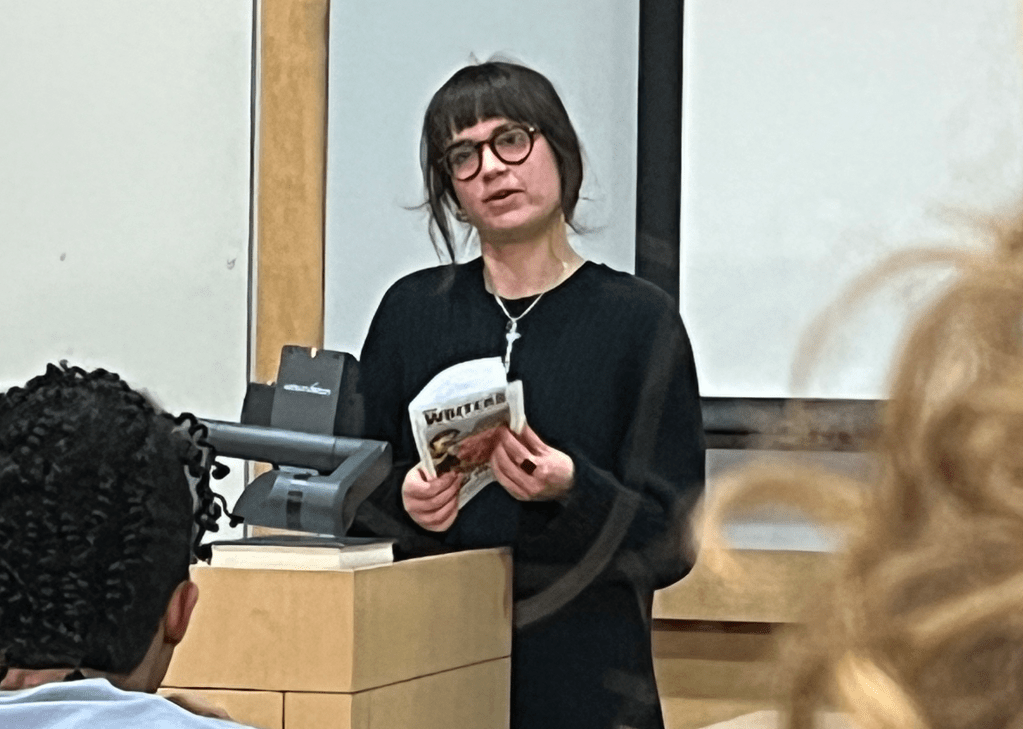
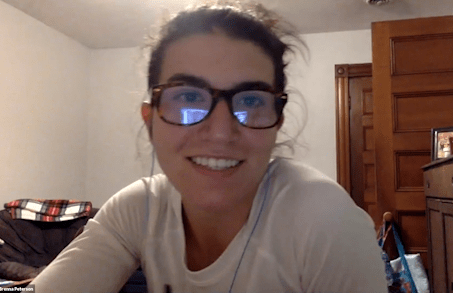
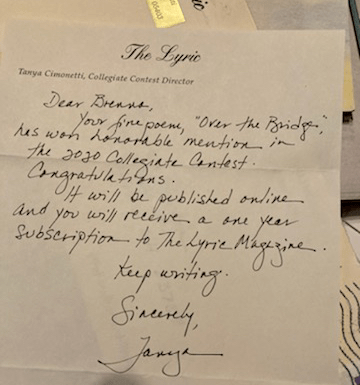
Our creative writers have earned recognition in many local and national writing contests. The most recent are Audrey Gorton, who won honorable mention in the 2024 Iris N. Spencer Poetry Award, and Brenna Peterson, who won honorable mention in the Lyric Collegiate Poetry Contest. (Read a story about it here.) Sophia Rowe‘s personal essay, “Gentle with the Small Things,” was a finalist for the W.W. Norton Prize and was published in the Norton Field Guide to Writing (2024) as an exemplary student nonfiction essay.
Other contests include the Christianity & Literature undergraduate writing competition—Brenna Case, Jessie Sorrells, Masha Tymchenko, Warren Wegrzyn, Sorina Kulberg, Kelli Garvey, Matthew Coburn, and Jenny Augst; the Ruth Lilly Poetry Fellowship competition—John Mirisola and Jenny Augst; the Natl. Federation of State Poetry Societies’ CUP competition—Lachlan Applegate and Christie Clause; Sigma Tau Delta Herbert L. Hughes Short Story Award—Talia Messina; the Taylor Making Literature Conference creative writing award—Jessica Sorrells & Jenelle Siegal; the Salem News poetry contest—Chris McClure; the Kennedy Center/American College Theatre Festival—Jon Busch’s “The Road to Rockville” (produced in NYC) and Sasha Irish’s “Black Fly Season” (produced at Framingham State).
Student Poets Recognized in National Competition
from the Gordon Tartan

By Evangelina Opoku-Nyarko
Staff Reporter
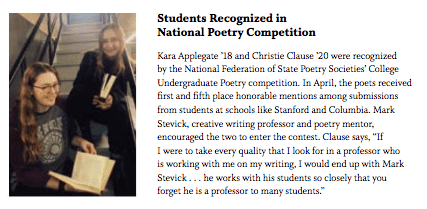
Two Gordon students, Lachlan Applegate and Christie Clause, received first and fifth honorable mentions in the National Federation of State Poetry Societies’ College Undergrad Poetry (CUP) competition. In addition to the two first places that the competition provided, it had five honorable mentions.
According to the students, the competition had about 1500 competitors from 37 different schools, including schools such as Stanford University, Columbia University and University of Michigan.
Participants were required to submit ten poems from which their writing ability was assessed and winners given a $500 cash prize along with having their poems published in a book.
Gordon College was one of nine schools to present multiple participants, two of which made honorable mentions.
Applegate and Clause were both very surprised at the outcome of this competition with neither of them really expecting to make it to the top. About a month after their submissions, both students received a congratulatory email from President Lindsay honoring them for their honorable mentions, surprising them for the organizers of the competition had yet to contact them.
In fact, both mentioned that they initially believed this to be a mistake until Stevick contacted them confirming their achievement.
This was Applegate’s first poetry competition. She explained that she had planned on following the example of Stephen King, by pinning rejection letters on a board but discovered this unnecessary with her win.
Clause, on the other hand, had won a few statewide competitions before, but never achieved recognition on the national level. She was nervous submitting and felt her odds of winning were slim.
Despite the shock of how well they had done, both poets agreed that their hard work had paid off and the recognition earned.
Both students were introduced to this competition over winter break by their professor, Mark Stevick.
Coincidentally, towards the end of their creative writing class last semester, Clause and Applegate were matched to work together in a peer review workshop. Clause credits her work with Applegate as a needed push within her poetry writing.
Both Applegate and Clause attributed their success to the encouragement given them by Stevick. They attested to the fact that he invests in each of his students and pushed them to articulate their voices better.
They believed their chances of winning may have been different without him, not to downplay their abilities, but because his encouragement was just what they needed to push them up.
This achievement meant a lot to both students. Applegate sees this as a validation that she could get published one day.
Clause said it helped renew her faith in her writing ability. Though she had received affirmation from family and friends, she was thrilled to be recognized by professionals in the field of poetry.
She stated, “This achievement means that I’m on the right track and that what I have to say is worthwhile, which is exactly why I write.”
-letter from the chair
Dear Prof. Stevick, Just a note to thank you for promoting our Natl. Federation of State Poetry Societies’ CUP competition. You will be pleased, I know, to learn that among the several manuscripts I received, Gordon students Lachlan Applegate and Christie Clause received awards in a highly competitive contest that included entries from schools all over the country, including Stanford, Columbia, Oberlin, and U of Michigan.
I applaud whatever you are doing at Gordon to turn out such promising young writers. Your students will have their names and their school listed in the winners’ chapbooks, which will be marketed internationally through Amazon.com.
Congratulations to you, your fine college, and your fine student poets. I will be sending the poets an official letter via USPS, but the email notification should go to all entrants by tomorrow.
Cordially, Shirley Blackwell, CUP chair
Sigma Tau Delta Herbert L. Hughes Short Story Award
How a Career Path Can Grow in the Liberal Arts—Including International Honors
At age nine, an elementary school student with pen and paper in hand created a short story about a man with no name. Being in third grade, Talia Messina wasn’t thinking about sharing her story with the world; she was busy doing what nine-year-olds do. She shared it with her mother, but then neatly folded the paper and placed it in a box filled with doodles and writings—where it would remain throughout her childhood. Eleven years later, Messina walked into her first creative writing course. What she didn’t realize is how the course would reshape her academic path and lead to a recognition from the international English Honors Society and her debut publication.
“I was a kinesiology major when I first arrived at Gordon,” said Messina, whose new friends at Gordon enjoyed reading her writing and insisted she might be in the wrong major. Instead of a career in nursing, these friends envisioned a different career idea for Messina—a life as a writer. “Truth be told, I only registered for Gordon’s Creative Writing course due to my friends nagging and insisting how much I might enjoy it.” Turns out, they were right.
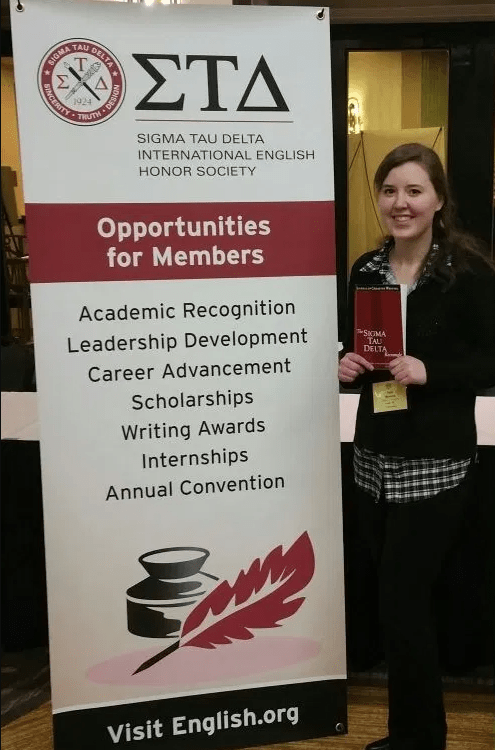
At a liberal arts institution where vocation unfolds in a student’s academic journey, Messina recently received the Herbert L. Hughes Award: Short Story Award for “best original fiction,” from Sigma Tau Delta—the international English honors society. She was selected to be one of nine college/university students to have her story, Man With No Name, published in Sigma Tau Delta Rectangle (p. 75) and cataloged with the Library of Congress.
Messina also received a Distinguished Achievement Award from Gordon’s Alpha Upsilon Omega chapter in recognition of her outstanding accomplishments as a writer, especially the publication of her story.
She recently returned from the annual Sigma Tau Delta International English Honors Convention in Cincinnati, where she was asked to read The Man with No Name at the opening ceremony. She says it was “the best moment of my life.” While there, Messina presented another short-story, The Skylark and Her City, which was accepted to the convention, and included a panel reading.
As the first Gordon student to receive such an award, she was honored for “advancing, in some extraordinary way, the interests and prestige of Alpha Upsilon Omega beyond the campus of Gordon College” said Dr. Chad Stutz (English) during the ceremony speech in April.
Messina, soon graduating with her degree in English and a minor in psychology says she “praises the Lord for this blessing and the affirmation of her talent,” and is grateful for the guidance of her professors.
 Ars Creative Writing